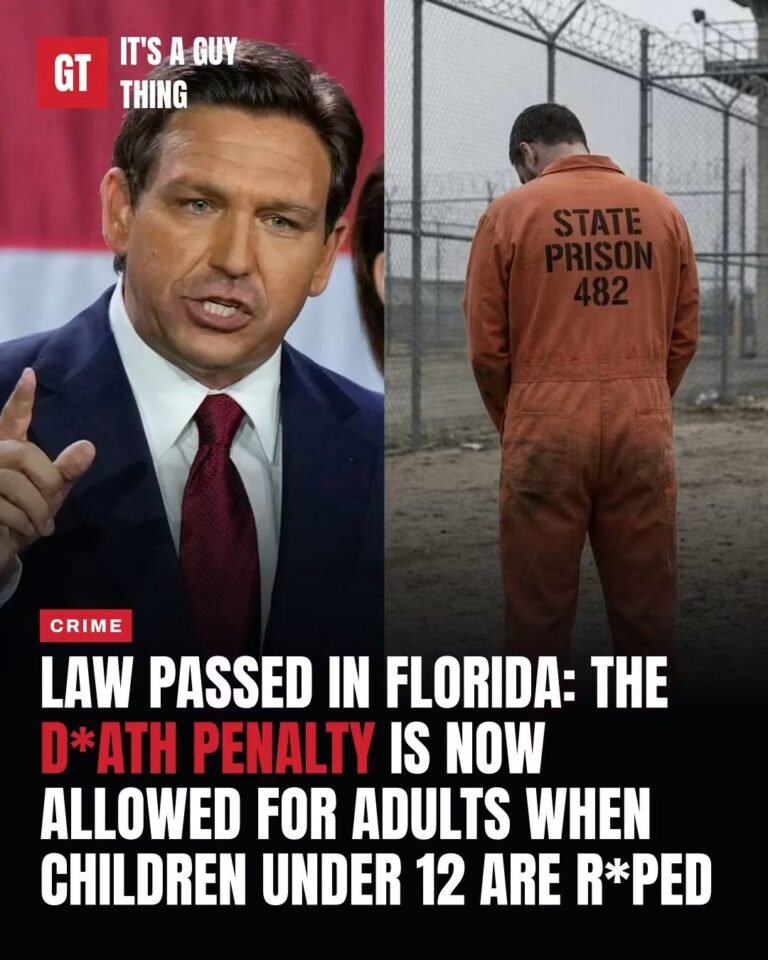
Florida became the first state in the nation to authorize the d*ath penalty for the r*pe of a child under 12 when Governor Ron DeSantis signed House Bill 1297 into law in May 2023, a measure explicitly designed to force the U.S. Supreme Court to revisit its own precedent.
The bill passed 95-14 in the Florida House and 34-5 in the Senate, giving prosecutors the option to seek ex*cution for aggravated s*xual battery of a child under 12 and laying out a penalty phase in which a jury must first convict unanimously before at least eight jurors can recommend d*ath. The law directly conflicts with Kennedy v. Louisiana, the Supreme Court’s 2008 ruling that found ex*cuting a man for r*ping his 8-year-old stepdaughter unconstitutional because the crime did not result in the victim’s d*ath. State Senator Jonathan Martin, the bill’s sponsor and a former prosecutor, told colleagues that s*xual battery on a child needs the most serious punishment and the most serious penalty available.
In November 2025, Florida Attorney General James Uthmeier moved to test the law directly, announcing the state would seek the d*ath penalty against Nathan Holmberg, a Hernando County man indicted on seven counts of s*xual battery of a child under 12 after he was accused of recording himself r*ping and coercing young children. Uthmeier called on the Supreme Court to reverse its 2008 precedent, describing the crimes as pure evil, and said such acts deserve the ultimate form of justice.
Tennessee, Idaho, Oklahoma and Arkansas have since passed similar statutes, betting that a reshaped court, with three of the four original dissenting justices, Chief Justice John Roberts and Justices Samuel Alito and Clarence Thomas, still sitting, might reverse course. Opponents warn the strategy is legally reckless. Michelle Suskauer, a West Palm Beach defense attorney and former president of the Florida Bar, has asked where the line will be drawn and what other charges will eventually be included, while Maria DeLiberato of Floridians for Alternatives to the D*ath Penalty has called the state’s push to overturn the precedent unusual and harmful.