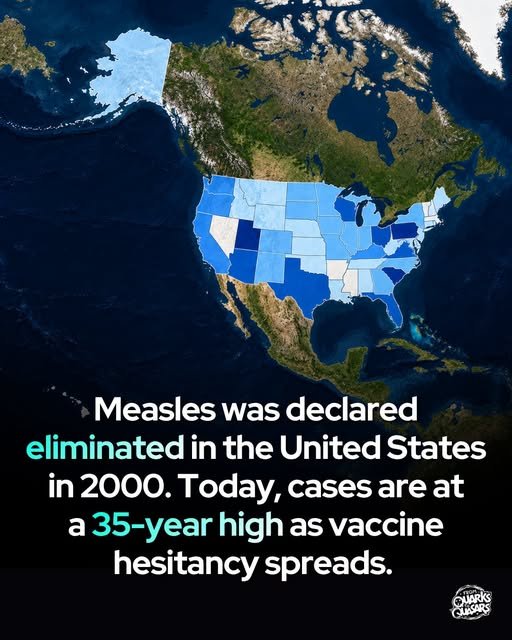
The United States is having its worst year for reported measles cases since 1991.
The CDC had recorded 3,471 confirmed cases in 2026 (as of September 18), already exceeding the 2,289 reported during all of 2025.
About 95% of this year’s cases were linked to outbreaks.
Measles was declared eliminated in the U.S. in 2000. That meant continuous domestic transmission had been interrupted, not that the virus had disappeared worldwide or could never return.
Travel-related infections can still introduce it. When the virus reaches communities with gaps in immunity, it can spread quickly.
Measles is extraordinarily contagious.
It spreads through the air and can remain infectious for up to two hours after an infected person leaves an area. Up to nine out of ten unprotected people close to someone with measles can become infected.
People can also spread the virus before the telltale rash appears.
The illness often begins with fever, cough, runny nose, and red, watery eyes. A rash follows, usually starting on the face and spreading downward.
Complications can include pneumonia, brain inflammation, and death. Young children, pregnant people, and people with weakened immune systems face greater risks.
Declining vaccination coverage is leaving more communities vulnerable. National averages can also hide local pockets where protection is much lower.
Two doses of the measles, mumps, and rubella vaccine are about 97% effective at preventing measles.
Checking vaccination records is a practical step, especially before travel or during a local outbreak. A healthcare professional can advise whether additional protection is needed.
If you suspect measles, call ahead before visiting a clinic so staff can arrange care without exposing other patients.
Learn more:
“Measles Cases and Outbreaks.” CDC
The United States is having its worst year…
Create new listing
×
Post an Ad
Discussion
Send a private message
Comments
People forget that now these unvaccinated people have caught and recovered from measles, they now count towards the threshold of herd immunity. They chose their way, they caught it naturally, now they have immunity. If you are vaccinated, you have nothing to worry about from the unvaccinated who catch and recover from measles. They just got vaccinated the natural way. It’s ok. It’s their choice.
Risk - Reward - with the reward of vaccinating the statistical winner. The vaccines previous generations did not have to avoid illness epidemics - and loss of life are being dismissed by the ignorance of negative propaganda. I feel sad parents are being mislead when we know they want what is best for their children. Listen to doctors and professionals.
Ya know, if you put it in another context it's like saying, because we have insulin, there is no more diabetes. But you need to take your insulin or it will come back. That's a drastic oversimplification, but it's about the same level of brain power as antivaxxers, so....
Measles is much more than just a rash; it severely compromises the immune system and can cause serious complications: Pneumonia: The most common cause of measles-related death in young children. Encephalitis: Brain swelling that occurs in 1 out of 1,000 cases, sometimes leading to permanent brain damage or deafness. SSPE (Subacute Sclerosing Panencephalitis): A rare, entirely fatal degenerative brain disease that lays dormant and kills the individual 7 to 11 years after they initially contracted measles.
Just a little math here, unless these are all infants and children, this has nothing to do with current vaccine hesitancy. The vaccine is given at 1 and 4 years. That would math out that current cases would be overwhelmingly with people that did not get the vaccine years or decades ago and have zero to do with 2026 or the current administration.
The sick and dead children are the responsibility of their brain dead parents. I was born into the prevaccinated era. I had measles and chicken pox. I remember three younger siblings with whooping cough. However my parents embraced inoculations against polio when it was available. They made good decisions for their children related to scientific advances. Thank you, Mom and Dad
Measles are awful I had them when I was little ! I feel for all the children with them ! Please vaccinate your children
Funny 2000 the US had 150 active cases of the measles....CDC declared it eliminated. 2001 the US had 1500 active cases. The least number of active cases since 2000 when it was "eliminated" was 2020 with 13 active cases. Of course, I have to wonder if there weren't more that year and the CDC just stopped tracking it when COVID arrived like they did the flu. Id a disease eliminated if there are active cases? How does that work?
And to think in the 50s and 60s our mothers had measles parties and would get the neighbor hood kids together so they could all get it and get it over with, the school system didn't like the measles because it disrupted the school with most of the classes being out for a week they are the ones that pushed for the vaccine to be mandatory in the late 60s it wasn't because of the threat of death.
I hope you parents told your children the horror stories you and your parents knew. I heard from my parents and grandparents about growing up before vaccines for childhood diseases were common. My parents told me how ABSOLUTELY TERRIFIED they were their children would die or be horribly disabled by one of these diseases. I remember my parents and grandparents getting tears of relief in their eyes talking about when vaccines for different diseases became available and how they rushed us out the minite they were available They told me about standing in lines that went from the grade school cafeteria down the hall and wrapped all the way around the school to get the polio vaccine how they gladly waited however long it took. I passed those horror stories on to our children. None of our kids are stupid enough to belive the bullshit anti-vaxers claim. They know we love them and wouldn't lie to them about what polio, diptherea, measles and the other ancient diseases did in "the olden days". Make sure your grandchildren and great grandchildren hear the "olden days" stories of what those diseases did. Tell them about "IRON LUNGS" show them the pictures of living in the "iron coffin" for life make sure they know and understand these childhood diseases are not the simple little sniffles the anti-vaxers are lieing about. They are serious diseases that can easily kill or maim and just because some people survive doesn't mean their children won't be one of the children to die or suffer a debilitating disability. Tell them about the girl that lived next door who never went back to school because measles encephalitis damaged her brain and her parents and brothers had to take care of her for the rest of her life. Tell them about half the school class was missing after diptherea swept through the neighborhood during the summer. Show them the pictures of the children crippled by polio wearing braces or in wheelchairs. Explain to them about the graves in the cemetery where 5 or 6 family children are buried who all died within 6 months of each other as one after another caught pneumonia Never let it be forgotten what these diseases used to do to people back in the bad old days before vaccines were available. REMEMBER THAT'S WHY YOUR PARENTS VACCINATED YOU BECAUSE THEY KNEW AND UNDERSTOOD JUST HOW DEADLY CHILDHOOD DISEASES ARE. VACCINES HAVE DONE SUCH A GOOD JOB PREVENTING THESE DISEASES PEOPLE HAVEN'T HAD TO DEAL WITH THEM AND THEY'VE FORGOTTEN HISTORY Antivaxxers are proving their wrong one ancient childhood disease death at a time ROFLMAO Last year in texas 3 people won the ultimate DARWIN AWARD This year in Pennsylvania 4 people have won the ultimate DARWIN AWARD It should be interesting to see who the 30% of the antivaxxers and their children win the DARWIN CONSOLATION PRIZE and go blind, or deaf, or brain damaged LET THE DARWIN VACCINATION GAMES BEGIN
Pursuit of safety almost always costs some freedom and vice versa. It's unfortunate that each side affects the other, but it is inevitable. One side wants you to be responsible and protect them, the other side wants you to leave them alone and let them choose. We could start by appreciating the concerns of both sides, because constantly fighting isn't solving anything--and it's probably achieving something far darker than measles.
Why does the technique of manipulating the masses work? The manipulation of the masses can work because it takes advantage of normal characteristics of how the human brain functions and how people behave in society. It does not mean that everyone is easily manipulated or that it is inevitable, but there are several well-studied psychological mechanisms. Some of the most important are: 1. Emotions outweigh reasoning. When a person feels fear, anger, outrage, or excitement, they tend to analyze information less and make quicker decisions. Messages that appeal to strong emotions are often spread more easily. 2. The need to belong to a group. Human beings are social. If we believe that “everyone thinks the same way,” we are more likely to adopt that opinion to avoid being isolated. 3. Confirmation bias. People tend to accept information that confirms their existing beliefs more easily and are less likely to question ideas they already agree with. 4. Constant repetition. A message repeated many times can seem more believable, even if there is no solid evidence to support it. This phenomenon is known as the illusory truth effect. 5. Perceived authority. If a statement comes from someone regarded as an expert, a celebrity, or a person in power, many people are more likely to consider it credible. 6. Information overload. When there is too much news, too many opinions, and too much data, it becomes difficult to verify everything. In that situation, people often rely on mental shortcuts or familiar sources. 7. Social pressure. Seeing that many people support an idea can lead others to accept it, even if they have doubts. This is related to the psychological phenomenon of conformity. 8. Simple narratives. Complex problems usually have multiple causes, but simple explanations with a clear “villain” are easier to remember and share. These techniques have been used by governments, political parties, businesses, religious groups, social movements, news media, and advertisers. They are not unique to any one ideology or country; they can be used for positive purposes (such as public health campaigns) or negative ones
Legacy media brainwash (like TV news, newspapers, and major networks) can influence or "brainwash" viewers through subtle, repeated psychological and structural tactics that shape what people believe and accept as normal — often without them noticing. Here's a short, simplified breakdown of the key ways it happens: - **Deciding what matters** (agenda-setting): They choose which stories get lots of airtime and which get ignored → you start thinking the highlighted issues are the *only* important ones. - **Repeating messages** (illusion of truth): Saying the same claim or slogan over and over (even if debated) makes it feel true just because it's familiar. - **Using strong emotions** — especially fear, anger, or outrage: Constant crisis coverage keeps viewers emotionally charged, making it harder to think calmly or question the narrative. - **Creating "us vs. them" enemies**: Portraying certain groups (political sides, immigrants, foreign countries, etc.) as dangerous threats → unites viewers against a common "villain" and distracts from bigger problems. - **Selective facts** (cherry-picking or omission): Show only evidence that fits one side, leave out contradictions, take quotes out of context, or bury inconvenient stories. - **Personal attacks instead of debate**: Attack the person (their character, motives, intelligence) rather than their ideas → viewers reject whole viewpoints without looking at the arguments. - **Simplifying everything**: Present complex issues in black-and-white, child-like terms, and rely on "expert" anchors or officials as trusted authorities → discourages independent thinking. - **Slow, gradual changes** (gradualism): Introduce unpopular ideas or policies bit by bit over years so people get used to them without big backlash. These aren't usually one big lie — they're layers of repetition, emotion, selection, and framing that narrow what feels like "common sense" over time. Both left-leaning and right-leaning outlets get accused of this, depending on who's watching. **Quick defense tips**: Watch multiple opposing sources, search for what's *not* being covered, notice when you're getting angry/upset (pause!), and remember repetition alone doesn't make something true.
If only the country was actually all blue like this. Just imagine the progress we would have in every aspect of society
People are influenced by those in power and those that put them there, however people have to use their own common sense and in that there seems to be a lack thereof these days .😏
I like the word declared. But we know that isn’t true. While cases were low in 2000 sitting at 13 recorded there have been measles cases every year in America since all of us have been alive.
My body, my choice, or not my body my choice, that is the question. Is it nobler to suffer the slings and arrows of outrageous freedom or to embrace the Safety of communalism and by embracing believe thyself safe
I had measles as a kid. I stayed home from school. I was home alone,10 years old. I got worse as the day progressed. Around 3 pm I had a very high fever. I started to hallucinate. I saw the walls moving. The tv was trying to pull me into the screen. I as to turn the tv off. My mom got off wor and came home. I had red bumps all over and my fever was 105. My mom got my dad to get ice and they put me in the tub with ice water to get my temp down. Even then it was 103. My mom took me to the doctor the next day. He said they did the right thing, I could have died. They said if it got to 104 go to the ER. I was very sick for days. I don’t remember for how long. I was lucky, I survived. Barely.
There is no good reason for children to suffer from a disease that science has been able to control and eliminate. Children should benefit from science, not be the ones who suffer from ignorance.
At first I laughed when The Matrix referred to 1999 as the peak of our civilization. Now I shake my head knowing they were likely correct…
Death wasn't the only bad effect of the measles virus. Pre-Vaccine Measles Statistics (1958–1962 Average) Annual Cases: ~500,000 reported cases (with an estimated 3–4 million actual total infections) Annual Deaths: ~432 to 475 reported deaths Hospitalizations: ~48,000 per year due to complications like pneumonia and croup Encephalitis: ~1,000 cases per year involving dangerous brain swelling.
Concern should have been expressed more than 10 years ago. Mexico has had more than 40 deaths since 2005, with multiple thousands of cases. When comparing measles outbreaks among wealthy nations, the most meaningful comparison is cases relative to population and the same general time period, rather than simply comparing raw case totals. The United States has experienced a major resurgence in 2026, with **3,294 confirmed measles cases reported as of September 10, 2026**, the highest U.S. annual total in more than three decades. With a population of roughly 342 million, that equals approximately **9.6 cases per million residents**. Canada experienced a substantially larger per-capita outbreak in 2025, reporting **5,425 measles cases** in a population of roughly 41 million, or approximately **131 cases per million people**. Canada subsequently lost its measles-elimination status after sustained transmission of the same measles virus strain for more than 12 months. The United Kingdom also experienced a major resurgence: in 2024, the UK reported **3,681 measles cases**, equivalent to roughly **53 cases per million people**, and the UK subsequently lost its measles-elimination status. England alone reported 2,911 laboratory-confirmed cases in 2024. These figures do not mean the U.S. outbreak is insignificant. More than 3,000 cases in a single year represents a substantial deterioration from the very low levels seen in the United States in recent years. However, it does show why international comparisons should use **cases per million, comparable time periods, and comparable case definitions**, rather than simply declaring that the country with the largest raw number of cases has the worse measles situation. On a per-capita basis, the recent Canadian and UK outbreaks were considerably larger than the current U.S. 2026 outbreak.
Measles weren't a big deal when I was a kid 2 of my neighbors had them they got to stay home from school!
Not everyone who gets measles goes to the doctor. It’s not necessary unless you can’t control the fever. Measles was never eradicated.
As a strange coincidence I’m just now reading a novel in which a pregnant woman becomes frightened after hearing that there’s a case of measles in the village. She is aware of the terrible consequences for the baby if she contracts measles. She is determined to stay home until danger has passed.
Well, instead of the internet making people smarter, the exact opposite happened. I wrote about this and the detriment it would cause in my English literature paper about 20 some years ago. Got a A+ 😂 👍
What are the numbers of cases and deaths? If it was eliminated in 2000, then 1 case would be a 26 year high.
Midterm measles
As a military child, I got so very many vaccinations. Required by the Army for many reason like international travel and so on. Kept me healthy and im greatful. BTW, administered my an Army doc, no pediatric in my day. Just a stern look and told to hold still. Imo vaccination saves lives.
Let’s put this into perspective for the emotional thinkers who see this headline. Thus far, this year’s cases are 100 & change more than a typical year. “Eliminated” is medical word play, meaning we went a single year without a recorded case.
So exactly where did the new infections spring from? If it was eradicated within the US - no being vaccinated would not cause spontaneous outbreaks . It has to be either individuals were exposed abroad and brought it back OR it came into the country by non vaccinated visitors or immigrants. Wonder which is more likely?
You should also include that a vaccinated person can catch measles and also pass it along to others, so it’s not just that if it hits unvaccinated people, but anyone can catch the measles and spread it. Hope this helps.
I’ve always had faith in vaccines, but somewhere in the back of my mind I often wonder if we know all the facts about the side effects, not anti vaccine just find it hard to cipher through all the data
I'm thinking a lot of people would benefit from a time travel experience 70 years or so back in order to experience the full 1950s measles experience. I had the measles in 1956, very high fever (my parents told me I was delirious). And I was actually fortunate in not having any long-term results. Most folks dismissing measles were vaccinated as children.
But did you die? Infants who are breast feeding, receive antibodies from their mother which gives them protection from many diseases
Measles easily spreads by airborne transmission. That is why we need very high vaccination rates. Virus particles released by a transmitter will likely find any unvaccinated persons in the room. Just look at the number of measles cases immediately before the vaccine vs. after.
Yep 2000 is when the anti Vaxx movements pretty much started. They believe that one doctors research that claimed that measles vaccination was the cause of autism. Even though recorded autism cases were documented way before the vaccine ever came out. Now you look through history, and autism is actually recorded for hundreds of years, but people thought their children were possessed.
The number of people in these comments confidently arguing that measles was never “eliminated” because cases still occurred afterward is a pretty good demonstration of why knowing the difference between elimination and eradication matters before correcting epidemiologists about epidemiology.
Common sense, brain power, and trust in science is at an all time low. Support your local high school science teachers.
Vaccine ignorance, not hesitancy